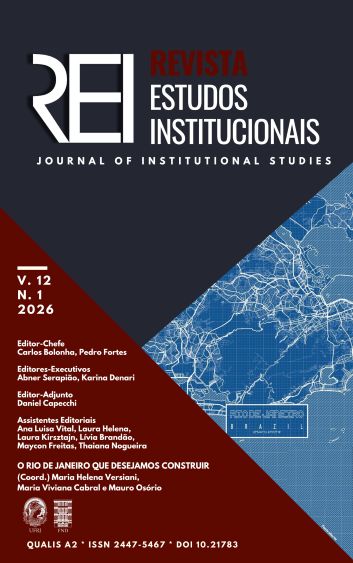
THE RIO DE JANEIRO THAT WE WISH TO BUILD
Keywords:
Rio de Janeiro, Crise Fiscal, Receita Tributária, Federalismo fiscal, Estrutura produtivaAbstract
This article analyzes the recent revenue trajectory of the State of Rio de Janeiro compared to other states, with an emphasis on ICMS revenue and its relationship with the state's productive structure. It argues that Rio's fiscal problem is concentrated on the revenue side, as the state has not kept pace with the national growth in tax revenues. Using data from the National Treasury and the IBGE (Brazilian Institute of Geography and Statistics), the study shows that, between 2015 and 2024, Rio de Janeiro experienced one of the lowest ICMS revenue growth rates in the country, in addition to low growth in current transfers. Property revenue, composed primarily of oil royalties, was insufficient to offset these lags. Using a fixed-effects panel model, it is observed that ICMS is strongly associated with the value added of the public and private service sectors, and has very little correlation with the industrial sector, whose expansion in the state is heavily dependent on the extractive industry. The article concludes that Rio de Janeiro's fiscal crisis stems from a structural imbalance between its productive base and its revenue collection capacity, exacerbated by tax relief policies. The article also discusses the expected effects of tax reform and the Full Debt Payment Program (PROPAG) and its relation to the state's structural revenue constraints.
Downloads
Downloads
Published
How to Cite
Issue
Section
License
Copyright (c) 2026 Maria Helena de Macedo Versiani, Maria Viviana de Freitas Cabral, Mauro Osório

This work is licensed under a Creative Commons Attribution-NonCommercial 4.0 International License.
The authors hold their copyright and concede to the JOURNAL OF INSTITUTIONAL STUDIES the right to the first publication, in accordance with the Creative Commons Attribution license.
Authors are strongly encouraged to publish their manuscripts in other medias, such as institutional repositories and personal pages. The Journal only requires the credits of the first publication.